Saturday, September 25, 2010

Jeddah, The Red Sea, and Beyond

   The last several days have been full of fascinating adventures in Saudi: two and a half days in the major city of Jeddah (4 million), snorkeling in a well secluded cove north of Yanbu, wandering through Old Yanbu town at 10 at night, and all the while teaching very enjoyable classes, enjoyable students, and enjoyable curriculum. Man, it hardly gets any better. Well, ok, the temperature could relax a bit; I think it's made its point.
Jeddah seen from the air is exciting for first-timers like us, but in the end it looks like any big city except with far fewer high-rises, so I'll spare you the photos from the plane. Mall life in Jeddah is quite impressive if you like that sort of thing and many many do, but after seeing Starbucks and MacDonalds and TGIFriday's for the umpteenth time among the abaya shops, sports shops, and so on, I opted for the souks of old Jeddah, markets dating back a long long time, well into the Middle Ages. And perhaps the oldest commodity traded there has always been dates, and did I find a date shop. You wouldn't see this next to a Starbucks.
The people in the shop were most welcoming and, quite frankly, I was stunned by the variety of dates, spices, and assorted sweets. Dates rolled in sesame seeds (that's my order he's selecting in the photo), dates with almonds, dates in honey, dry dates, soft sweet dates, more dates than you can imagine. The whole thing was such an enjoyable experience, I thought about applying for work.
   Predictably, the souks are colourful in ways that North American-style malls aren't. Shops featuring beautiful bolts of cloth in all colours sold by men in stunning white thobes, less upscale shops specializing in rugs and wall-hangings, quite classy gold shops and silver shops, high-end shops with walls lined in an incredible variety of men's perfumes, steaming restaurants and food shops down crowded alleyways, all ready to sell you what you need. A wonderful relief about the souks, this with the crowded markets of Beijing still ringing in my ears after two years , is that no one is shouting about his wares, no one is badgering the window shoppers, the strollers, or the foreign geezers. I was never hassled nor harried, although one somewhat desperate looking fellow did try to sell me a pretty dodgy looking watch, but with the lowest of voices and the gentlest version of prodding hopeful insistence I've come across in a market. Here's a colourful shop window and below you see Rose and our good friend Marsha Phelps, new grade six teacher, trying to decide on which new abayas they'll get from one of about a dozen abaya stalls we saw when we returned to the souk late in the evening after my reconnoitering visit in the morning.

   The snorkeling adventure went much better this time, although Rose stayed home to get caught up with school work. She'll get her trip in a couple of weeks when Borden and Anita take us, the couple we originally tried to go with two weeks ago. The trip up the coast was eventful in that the low-lying and quite rugged mountains were well within view, camels grazed along the roadside but did not find us nearly as interesting as we found them, and as always the speed of most drivers was enough to make me happy we were only going 120km an hour.
   This spot is a fairly secluded cove about two km off the main highway, a multi-laned road much like the new sections of Hwy 10 near Toronto except for the fact that the strip of land which separates the two sets of lanes does not include a turn-off for drivers coming from the south, as we were. It was clear from the tire tracks in the sandy divide that one is expected to simply drive down into the divide and up the other side in order to cross the other lanes and get onto the road leading into the beach. A bit unusual, but look at the money the country has saved by not creating intersections.

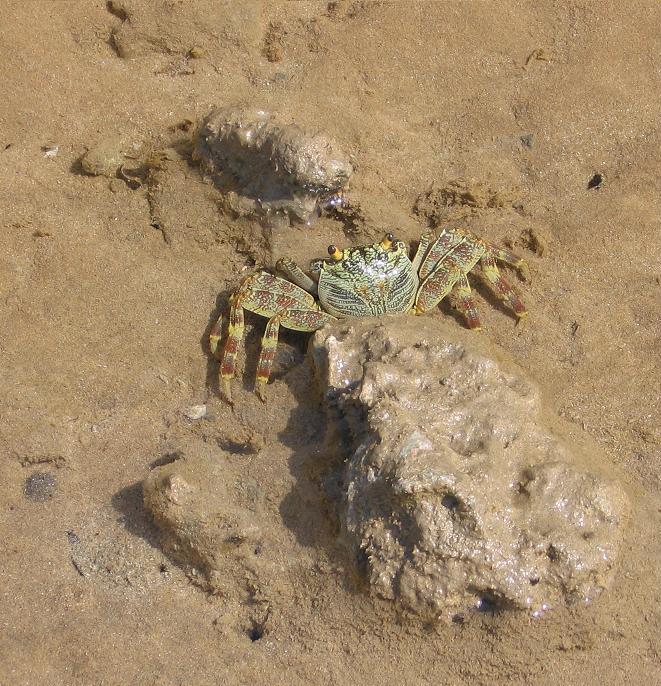
    Besides the water being a lovely temperature for swimming, besides the geographic delights of the surrounding area, what mattered most was the marine wildlife, both the long gone and the very much alive. If only I'd had an underwater camera, I could show you the gorgeous colours of the coral, of the zebra-striped fish and gold fish, of fish dappled in all the colours you can imagine. But you'll have to settle for this crab I found. The other photo is of some exposed rock along the shore and you can see how most of it is actually the bones of ancient sea life, a fossil hunter's dream. By the way, if you click on the picture of the beach, you'll get a better look at those dark spots in the water, many of them quite close to shore; those are all coral outcroppings and each one is its own little underwater world. I'll try to get pictures to show you what I mean when we go in a week or two.


    We finally made it into the older part of Yanbu, where so many of the locals do their daily buying and selling. We visited a brass shop with a very colourful owner who was quite friendly and chatty, willing to lay out many many rugs for our consideration or tell us the story of the various items we showed the least bit of interest in. He's been in the same spot for 21 years and is the type of shop owner who makes going into the town a much superior experience to shopping at the mall. Our prize purchase is a cloth we're using as an end-table cover, a lovely piece of work which cost us all of 25 riyals (about 6 dollars). You can see my foot in the photo by which I cleverly create a sense of scale (note the fancy pj's purchased that same day).
   For those of you wondering about the school and what the teaching is like, we're saving up some photos and stories in order to have one whole blog be about our school life. As I mentioned in my opening, we are quite enjoying the staff, the students, and the teaching. Rose is even insisting I take a photo of the school cat Elizabeth, or as Rob Phelps calls her, Lizard Breath, to include in the blog about our working day. I feel I should get permission from the various people in the photos before I use them in my blog.  Perhaps the school will be the focus of next week's entry.

Sunday, September 12, 2010

The Regular Bazaar of Life

We're off to Jeddah early on Tuesday morning for a couple of days and are quite looking forward to visiting the old bazaar there, the souk, as markets are usually called here in Saudi. If you want to get a look at what the old one in Jeddah is like, type in SusieOfArabia (all one word) and click on Jeddah Daily Photo Journal; you'll find some great photos there of various aspects of life in Saudi. I was going to copy one or two of her photos to include here in my blog ahead of our trip, with due credit paid to her ownership of the photos, but I didn't have time to email and ask permission, so pay her site a visit yourself. You'll find some great stuff.

I mention the souk because as I lazed about in the pool this morning after my run (101F at 9:15 when I finished. Good Lord.), the only idea I could come up with for this blog was the variety of things we experienced this week. Nothing major, but many interesting, little things. So here's a souk, as it were, of the past week.

Take, for example, this display at the meat counter. I'm wondering how I would use these in the kitchen, and all I can come up with is beef stock. Any ideas? And how big would my pot have to be? Ah well, I can't kick about the culinary options open to us: many and varied.

Speaking of meals, we had a wonderful "end of Ramadan/beginning of Eid holiday" potluck by the pool the other night and as the sun set and darkness grew, the scene became a little magical. Not having asked anyone's permission to put their photos on the blog, I only include this one nighttime shot of our gathering. By 7:30 it is fully dark now; in fact, this has been the case since we arrived, a result of being so much closer to the equator than at home I guess.

Some of the senior students at the school have been trying to raise money for Pakistan flood relief and one of the ways they offered of doing this was creating henna tattoos for anyone who wanted one. These are the sort that wash off after a few days or so, and Rose decided to get one. The initial process ends up making it look like you've been decorated by someone adept at writing celebratory messages on birthday cakes. But once the "icing" dries up and falls off, thereby leaving a scattered trail of little brown droppings, the resulting tattoo can be quite lovely. Rose's donation of 10 Saudi Riyals was considered very generous (they only wanted four). So for about 2.50 Cndn this is what she got.


Most evenings we have a bit of time to see if anything decent is on tv, and every once in a while a good movie will come on (Blade Runner and Woody Alan's Small Time Crooks have been featured, but usually the movies are quite dreadful--The League of Extraordinary Gentlemen, for example) or there might be a Premier League game, an interesting piece on Discovery, or the BBC news channel which almost always seems worth watching, as do SkyNews and Aljazeera. But last night, as I was drifting off to sleep on the couch I gave the channel changer one more go round and was delighted to find an Arabic channel featuring several traditionally dressed men in those flawlessly ironed, sharply creased, and almost startlingly white thoabs sitting in a golden and chandeliered room discussing nothing that I was able to figure out. Until their very calm and reasoned discussion was interrupted by a clip of camel racing. After a moment of watching quite ungainly animals chase after one another, we were returned to the golden room and the extraordinarily dressed gentlemen quietly discussing the racing.

This pattern of discussion and breaking away to camel racing went on for some time. I found it fascinating. I've tried twice to upload a video clip of the golden-roomed bookies and the races, but I keep getting an error message (Is Big Brother watching?) so that won't work. Nonetheless, it makes you nostalgic for the bingo halls and horse tracks of southern Ontario. Here's a poor quality shot of the race taken while I was watching and another of the Arab gents. If you click on the picture, you'll get a larger version. By the way, I have no idea what that bus was doing, but it raced around the track with the camels each time.

Finally, the frangipani tree, pronounced with a soft 'g' as in fringe. Several of them grow on our compound and they have delicate white flowers year round. I'm also happy to see them because they are mentioned in a wonderful short story by Margaret Laurence, "The Perfume Sea," which I taught for years to my senior Literature class. Every time I see one here, I remember that story, that course, and why I still love teaching English.

That gives you a taste of the rich bazaar of life we've come to enjoy here in Yanbu. You can see that regular daily contact with Saudis is pretty limited, but we're hoping to make up for that soon with a trip into the nearby mountains where we'll also get to learn more about the Bedouin and in a couple of days when we make it to Jeddah and its ancient souks.

Friday, September 3, 2010

The Meaning of Inshallah

We've learned to say inshallah with some frequency over the last few days It means "god willing": getting our first paycheques cashed, inshallah, at the local bank without benefit of an account which we can't open because we don't yet have our iqama(our proof-of-residency card) which might come by the end of October, inshallah, as long as our paperwork is in order and the sometimes desperately slow wheels of Saudi bureaucracy turn the appropriate number of times, inshallah; getting our airline tickets which must be paid for before two o'clock, inshallah, at the travel agency for the 50 minute flight south to Jeddah two weeks from now, a process our New Zealand friend Ollie tells us could take 15 minutes, inshallah, or an hour and fifteen minutes depending on how long the line-up is and complicated by the fact that during Ramadan the office is only open from 10:30 to 2:00.

We hear it every day: on the bus taking us to work, in staff meetings, in the grocery shops. It's everywhere, and I suspect the reason for this is that you can never tell with any confidence what's going to happen, how long it will take when it does finally happen, and if it's going to work out in the end anyway. Things here can be maddeningly uncertain, so when things do work out as you might hope they will it is wise to assume Allah has decided to favour you, and it's even better to ask ahead of time with an "inshallah" aloud after every wish, hope, desire, or plan.

Take this morning's trip up the coast of the Red Sea, for instance.

The plan was to go north for an hour or so by car to a small cove with shallow waters and some spectacular coral reefs for a bit of snorkeling. Borden and Anita had set this up for us a week ago and we spent some time yesterday in one of the many pools on the compound learning to use the equipment people had generously lent us for the trip. Friday morning arrives, sunny and 94F, and by 8:30 we're loading the car with folding chairs, mats for the beach, coolers with snacks and drinks, towels, and all the standard beach paraphernalia. Two things, though, make this more than a trip to Sauble Beach or Wasaga. We have two massive containers of water, capable of keeping the four of us well hydrated for days, and "ladders" for the tires to grip the sand should we get stuck on the beach. These ladders are metal frames about two to three feet long, about eight to ten inches wide, and welded together so as to resemble a miniature ladder. The water and the ladders remind me that any trip out of town in Saudi has to allow for being stranded well out of town, and this always means at the very least lots of water.

With everything loaded, we're heading out of town and are driving along a fairly new multi-lane highway when, about 3 km out of town the highway ends quite suddenly in what turns out to be a villager's dusty sun-baked front yard. The highway just ends. We wind our way along bumpy narrow lanes between the village houses and emerge once again into someone's front yard where the multi-lane highway immediately starts again. It's the strangest thing. Borden tells us that the land for this village was a gift from the King to the owner of all the homes and he is reluctant to sell the King's gift to make way for the Yanbu version of the 401. I suspect it is simpler than that: he hasn't yet been offered what he thinks is appropriate compensation.

About two km later, the car overheats and we have to stop. Yanbu is still quite clearly in sight and the nearby mountains, less now than 30km away, loom impressively across very flat fields of quite scrubby brush and sand, lots and lots of sand. We inspect under the hood, and the problem is a mystery to the two of us. No leak, fluid levels clearly fine, fans working, but overheated nonetheless and foolish to go on without getting the problem solved. We limp back to town, stopping to allow the engine to cool every kilometer or so. And with every stop, as the engine cools, we heat up.

The best way for me to deal with the heat we endure as the car cools down is to get out into the sun and mild breeze with a bottle of water and feel grateful this problem didn't arise an hour up the road. Rose and Anita, on the other hand, stay in the car with the doors open, chatting, sipping lemon drinks. It's pretty clear the male fascination with motors and the problems they can cause cuts across vast cultural boundaries. Several Saudi drivers stop to offer help as we wait, hood up, fluids bubbling, and I get a lesson in sign language by watching Borden speak English to an Arabic speaking fellow about what's wrong and where it might be fixed on the Saudi equivalent of an Owen Sound Sunday. Lots of nodding, arm pointing, sweeping gestures meant to indicate heading off to the left or right in search of a mechanic. It's a strange dance.

An hour and twenty minutes after we left the compound in coral-snorkeling anticipation, we return with reassuring comments about being able to use the time to get some marking done. We'll try the adventure again in three weeks, inshallah, Borden and Anita suggest apologetically. With the opportunity of marking ahead of us, Rose and I change and walk out the front door into our front yard which is in fact a 14m by 7m pool. The water might be a decent temperature, inshallah. It isn't the Red Sea, and there isn't any brightly coloured coral in it, but it is cool and very refreshing.

Thursday, August 26, 2010

Saudi By Numbers

Aug 26th, 2010

Our number 3 has its origins, as do almost all of our numbers, in the Arabic system of numbers dating back well over a few thousand years. I selected three because in our first few days living in Saudi Arabia, or as the locals call it, The Kingdom, this number kept cropping up in curious ways. For instance, last Thursday, the first day of the weekend for those of us living in The Kingdom, we went grocery shopping at a couple of local supermarkets, similar in many ways to Zehrs or Metro, but different enough so that we were constantly aware of being in a foreign place. It was during this shopping trip that three numbers stood out for me.

The first number is 115. This is the speed our new friend Borden Hasiuk, science teacher at the school, drove along a pretty standard strip of road through a shopping area, much like driving 115km an hour along The Sunset Strip on a Saturday morning just after ten o’clock. And we had several drivers zip by us at what must have been 140 or 150. This was somewhat startling, as you can well imagine, especially if you are pulling out of the IGA lot or trying to turn right out of the Beer Store/McDonald’s entry road.

The second number relates to the first in that it is the price per litre in Canadian currency of the gas we bought to drive that speed: 3.68 Saudi riyals to one Canadian dollar, according to a recent newspaper, The Arab News 35 (the only national paper we can get locally), and 33 Saudi riyals per litre, resulting in a Canadian price of just under 9 cents a litre.

Nine. Per litre. That is absolutely loony, if you’ll pardon the Canadian coinage.

The third number is the price I paid for the most unusual item on our shopping list: camel meat.
We travelled along a busy street at 115 km an hour on gas costing 9 cents a litre to buy, amongst other things, camel meat for which we paid about 42 SR per kilo (about $12). Now, there’s nothing special about that number, but I thought you should know how much it costs to eat a camel. It’s the sort of information that, once you’ve got it, you realize how useful it is. And if anyone tells you it tastes just like chicken, I’m here to let you know it doesn’t; it tastes like chewy mild beef, sort of. See if Cottenie’s can get some in. You’ll see I’m right about this.

Here’s the best bit, though, about buying camel meat. To let the customer know that it’s available, the camel’s head is put on display in the meat counter, alongside its innards. Now why don’t they do that at Zehr’s? I’ve included a photo of the meat counter for your enjoyment, but I’ve put it at the end so you are warned ahead, sorry, of time. The picture right here is of the meal Rose and I enjoyed.

That’s Saudi by the numbers, so to speak, or at least our experience of it in these first few days of living in Yanbu on the Red Sea. I could have written about four numbers if I’d decided to include yesterday’s high temperature of over 45 C, but some numbers just don’t bear thinking about, even in the land where those numbers were invented.

Wednesday, August 18, 2010

What Time Is It?

Right. So it's Wednesday, just after a lunch the school provided of stirfry veggies and quail eggs with rice and ham-flavoured chicken. Are people that desperate for the taste of ham? And quail eggs . . . delicious. Are there flocks of quail somewhere in the desert? Secret quail farms, far from prying eyes?

But it hasn't all been quail eggs and ham since we got here. There has been work too, complicated by the fact that the new school we were to move into this week is not ready, so everything packed into boxes has to be unpacked so we can use it all again. Then sometime soon we'll get to pack it all up again for the move. But Saudi time, it turns out, isn't quite like what we're used to, especially during Ramadan. Everything slows down to accommodate the fact that no Muslims get to eat or drink during daylight hours, not even water, so they tend to stay up quite late at night making up for it. As a result, we are told, students live a kind of upside down life and can't always be trusted to be present or if present not always to be awake.

The long flights to get here, the seven hour time difference, and the associated jetlag have left the two of us pretty upside down as well, in terms of our sleep and general state of alertness. I discovered, for instance, last night while Rose struggled to get a few hours without waking up, that there is a lot to watch on tv between 2:30 a.m. and 4. I didn't even know there is an National Basketball Channel, and why it is available here in Saudi is an even greater puzzle. BBC World News is excellent, even that early in the morning; the same cannot be said for Fox (at any time of the day or night). The point is, Rose and I are still pretty muddled as to our body clocks and daily rhythms.

While our sleep patterns are messed up, our living quarters are not at all. See that lovely blue pool just steps from our door? Yesterday, just home from work, that pool looked so appealing I couldn't resist. Too hot to go for a run and too tired to try, I decided to go for a swim. It was like climbing into a bowl of soup, in terms of temperature that is, but a treat nonetheless. I won't bore you with details about the very spacious rooms in our villa other than to point out that our bed is the size of our deck in Owen Sound. Rose has to roll over and over and over to get close enough to hear me snore. It's like we've been given an acre, or is that a hectare, to sleep in. An air-conditioned acre, I might add.

Staff at the school have been very friendly and helpful, all the way from Paul Thompson, our Principal, to Johnny our head custodian. Everyone, it seems, wants us here and wants to do whatever it takes to make our stay and our work the best they can be. Paul has made it quite clear that he defers to his teaching staff regarding setting the curriculum, making the decisions about how best to teach the material, and what content is worth teaching. It's a bit of a strange feeling to be so trusted professionally.

Which brings me to the camel crossing signs. We've seen the signs but not the camels, and since the land here is as flat as flat can be, a camel should be pretty easy to spot. Alas, it hasn't happened yet.

Saturday, March 6, 2010

How It Happened


After an intense weekend interview experience at the Search Associates job fair in Toronto at the end of January, Rose and I have selected the Yanbu International School in Yanbu, Saudi Arabia, as our place of employ for the next two teaching years, beginning mid-August '10. You can see by the map we'll be right on the Red Sea, just north of the Tropic of Cancer.

To give you a sense of scale, Yanbu to Jeddah is about 240km.

It was a very difficult choice between Yanbu and Chengdu in China, but it came down to the fact that in Saudi we'd be teaching straight English. As our interviewer John Chapman put it, "Brad is the high school English Department and Rose is the middle school English department." As I put it, this should make for some interesting department meetings (over breakfast?).

Here's an excerpt taken from a very informative website with information about life in Saudi Arabia in general and Yanbu in particular:

YANBU

This was developed along with Jubail in the Eastern Province as an industrial city. Built on a smaller scale than its eastern cousin Yanbu comprises petrochemical & non hydrocarbon facilities plus a refinery & also the terminal of the East-West pipeline.


The precepts of Islam, together with deep rooted traditions founded on the customs of centuries, give to the Arab a deep respect for social dignity and courtesy. It is therefore important for foreigners to familiarise themselves with local custom. In particular, every personal contact, in all spheres of life begins with some form of courteous greeting and it is always much appreciated if foreigners take the trouble to learn Arabic forms of the greetings and responses which are, for this purpose, fairly standardised. Furthermore, a person visited must always stand up to greet and shake the hand of the visitor of any kind. Omission of this phase of the social or business contact give rise to automatic mild social offense. Arabs are understanding if a foreigner unwittingly commits a social blunder and make considerable allowances for shortcomings. Efforts to follow custom are highly regarded.

It is customary in Saudi Arabia for male relatives and close family friends to greet one another by kissing and for them to hold hands while walking and talking together.

The position of women in Saudi Arabia is far different from that in Western Countries. From an early age they live in extreme privacy and are not normally seen by men other than their husbands and close male relatives. In the houses of rich and poor alike, women have separate quarters into which only intimate members of the family are permitted, Accordingly, mixed social gatherings or parties are rare. The custom of purdah prevails in Saudi Arabia and women appear in public completely veiled from head to foot. It is most impolite to stare at them and on no account should they be photographed. European ladies are not expected to adopt purdah when outside the home but are expected to adopt sober, unrevealing dress, i.e. long sleeves, covered legs and high necklines. Except for taking part in sporting activities, European men are expected to appear in public with only arms and head uncovered.

The Arabs are justifiably famous for their hospitality and, while the standards of hospitality are set by custom, the Arab applies them with a warmth which reflects his enjoyment in entertaining his guest. The most usual gesture for the entertainment of an individual or small group is the serving of Arabic coffee or tea (sweetened and without milk) or soft drinks in offices and shops when the occasion arises. It is impolite to refuse these important tokens of hospitality.


Rose said early on in our search for an alternative teaching experience that she wanted to do something that put her "outside of her comfort zone". Well, I think we've succeeded in this. This should make for an experience both interesting and challenging.