Sunday, September 18, 2011

Back in Old Yanbu

One of the good things about being home sick from work is that I can make the soup I want without any concerns about whether anyone else will like it or not. Unable to sleep, I am now enjoying a soup stuffed full of garlic, ginger, cloves, fennel seeds, chicken, tomato, green and red onion. Delish. And, to add more spice to the sniffly, coughy, headachy day, Canada is about to play France in the Rugby World Cup (having upset Tonga already).

It seems a bit odd to have a full blown headcold in such a hot country, but germs are democratic so moaning about it seems pretty useless. Our return to the land of sand was in many ways much easier than our arrival at this time last year. The weather's better for one thing; still hot, but not as hot, and for obvious reasons not nearly so much of a shock to the system.

Rose is in her new Indian top, a lovely gift from Preetha, an Indian woman who teaches grade two and has a home in the south of India. We often see students in this type of top; in fact, often some Indian or Pakistani students will come to school dressed in the native dress of their homeland.

Speaking of traditional dress, here I am looking like a sharp dressed waiter this past Friday morning, serving tea to Rose and our friends Robert and Marsha on the pool deck about 7:30 in the morning. I'm wearing a traditional men's wrap from what were once the Dutch East Indies. Those are the red socks Rose knitted me for our 33rd anniversary, draped so stylishly over my shoulder. They should serve well on the cold Saudi nights.

We aren't the only ones dressed in seasonal finery. The frangipani trees are in full bloom, as you can see below. These trees abound on our compound but they don't grow anywhere outside of the well-tended gardens of compounds like ours.


Classes are well under way and it has been a real treat to see the students again. Here's a shot of my grade ten class, quite large by international standards: 26.

A few other typical sights include the watermelon seller at the side of the road,


the gorgeous parrots at the local mall,


the unfortunate camel at the local meat counter, and the beautiful bouganvilla outside our back door. And this is our latest acquisition, an unusually dark carpet we found at the local brass shop, hand stitched (as they all are, in fact) and about 40 years old.

Finally, or almost finally, we were out at the local night market where I took this shot of the bounty of produce on hand, all of it shipped into the country, probably from South Africa, the Jordan Valley, or the US. Not all that different, really, from the fruit and vegetable section at Zehrs, except maybe for the cleanliness of the floor.

So we're back and back at it, too. The year will slip along quickly and we'll be home again. I leave you with this photo of the two of us at our anniversary breakfast this past Friday morning. That red rose is from the bouquet Claire and Neil and Scott arranged to have delivered to us the evening before.

Warmest wishes to you all. May the coming snows not be too deep nor the winter winds too cold. xoxox

Saturday, April 23, 2011

Istanbul, or Carpets are Us.


I can't tell you how many times Rose and I heard something like "Haghia Sophia? Just this way. Where are you from? Oh, Canada. I have a brother (cousin, uncle, friend) in Toronto (Vancouver, Montreal). I am not official guide but I know a few things. The Haghia Sophia, it is very old, very beautiful. I own a small carpet shop just over here if you are interested." This happened every day, several times a day. The men hired to stand outside the various restaurants were much more imaginative: "Oh, there you are; we were expecting you earlier!" or "Did you want a table outside or inside?" And all of this in a friendly jocular way.


But the carpet guys . . . sheesh. I just started saying, "We live in Saudi Arabia and we've got all the carpets we need, and cheaper too." That generally shut them up or put them off and we could proceed in peace, until the next guy saw us, and he'd say, "Blue Mosque? Just this way. Where are you from? My brother is there." And so on. Just so you know I wasn't misleading them, here are two carpets we bought in Saudi. All hand knotted, gorgeous. The darker red one is half again as big as the blue one which is 5 feet by 3.5. They're a good size.

But so much of Istanbul more than makes up for what minor annoyance all of this turned out to be. In fact, we accepted the carpet men and their approaches as part of the landscape, another part of the cultural difference we had come to find in the first place. (Please, more tea. You are my brother.) Having arrived, the first thing I wanted to do was race up to the rooftop patio and see what Istanbul looked like at 7 in the evening. We'd read about being able to see the Bosphorus on one side and the Haghia Sophia (local signs for which read Aya Sophia) and a more romantic setting, it seemed, would be impossible. Despite the grey clouds, it was breathtaking to see a building as unlike any building I'd seen in person. Bits of it resemble St Paul's in London, but we were never able to see that from our breakfast table in any of the various places we've stayed in London. Sophia's dome has been visible since about 530 AD. The thing astounds in so many ways. Here are a few pics of some of the interior.
Notice the graffiti from1847. Some must be much older.


The balcony railing on the second floor was scratched full of graffiti, most of which I couldn't read. The mosaic you see was covered over by plaster when the place became a mosque  but has been restored to some extent. The place became a museum once modern Turkey was created in 1923. The figure you see in the centre--Virgin and Child--is from the 1100s, the other two added later.


Aya Sophia looking east.

I could go on and on about the history of the city--the ancient Roman remnants, the Byzantine aspects, the Ottoman, the Christian, and so on--but you'll get much better info on-line than you will from me, so I'll just go on with some more pics, and maybe a bit of advice.

For instance, if you go, be sure to visit the Grand Bazaar. The gold and silver is something to behold, not to mention the carpet places, many of which also sell gorgeous table cloths and prayer mats. But there are mountains of seriously overpriced tat. However, it's a carnival of colour, noise, spices, and pitchmen.


This is one "street" of dozens in the world's largest and oldest covered bazaar. If you click on the picture for a closer look, you'll see all sorts of different things for sale: dresses, scarves, more scarves, dishes, chess games, and on and on. There must be close to 50 shops dealing with silver, another 50 for gold, at least 100 that sell carpets, hand stitched tablecloths, and other impressive textiles, but not being a patient shopper, it all became too much.


It looks busy, but it is a beautiful piece. Who could resist?
Here's a pic of the tablecloth we bought, or as Rose likes to point out, I bought. Don't ask me why but we reached a point in our negotiations with the merchant where I simply fell in love with this piece, always a dangerous thing. His schtick was to refer to me as Brad Pitt and Rose as my Angelina Jolie.  I tried very to look  neither amused nor anxious to buy it, and we did manage to get it for less than half at what our man started at. Nonetheless, I expect his family will not go hungry. Here are two pics of the tablecloth. The stitching is all silk and the background is cotton. It was made over several months by a young woman who, in the tradition of her ancestors and like many young women, sewed it as part of the dowry she'd bring to her marriage. Our man, now another brother, told us it was at least 90 years old. Hmmmm . . . and maybe I'm Brad Pitt, too.


This is a bit of the detail work.

Istanbul is a very walkable city, or at least the centre of the European part of it is. There is also an easy-as-pie tram system that you can take advantage of once the hills get to you. And there are many hills to deal with. But you can tell by the number of street merchants desperate to sell you knock-off Hugo Boss socks, 12 pair at a time, or hoping with those slightly panicky eyes that you'll grace their tiny dusty shop and buy some cheap t-shirts or whirling dervish bowls, Istanbul is a city trying to pull up its lower middle class socks on the street while upper-end bars and cafe's hope to lure you in despite the ridiculously high prices. We visited the Pera Hotel, the final destination of all those well-heeled patrons of the Orient Express (Mata Hari, Hemingway--ok, not so well-heeled in some cases: he was a 24 year old reporter for the Toronto Telegram at the time--British novelist Graham Greene, Agatha Christie, Prime Ministers and Presidents, Mark Twain. They showed us the spot where a diplomat had been assassinated in the front lobby.). Our misfortune was to visit just after a 24 million pound makeover. This meant that in the fabled bar it only cost me 55 dollars for a double of Jameson whiskey and a glass of unpleasant red wine. I'd do it again though if I hadn't done it this time. The place was stunning (as were the prices). The wrought iron elevator is hand operated and rarely used, but a woman who maybe thought that at my advanced age the stairs might be too much, offered to give me a lift, so to speak. Creaky, but elegant. The elevator; not the lady. She didn't mention Brad Pitt.

There's a great little bookstore, Robinson Crusoe, which reminds me of our even better bookstore in Owen Sound (The Downtown Bookstore to those of you who are reading this from beyond the city limits). We walked out with three books by Orhan Pamuk, Istanbul's literary son.  Cafes and restaurants abound, and many of them offer excellent food at good prices. One curiosity of Istanbul is that the city is home to hundreds if not thousands of well fed stray cats. We spent a lovely 2 hours in a very old hotel restaurant, all glassed in, old wood, and plants. A large white cat came in with us and rather than shoooing it out, three of the four waiters who had nothing to do, played with the cat for 15 minutes, and then left it to wander about the place. Dogs stroll and nap their way around the city, too. On each of my runs, I came across dogs in small packs, but friendly, dogs asleep in parks, on sidewalks, on benches, on some pretty uncomfortable cobblestones. None were scrawny or scraggly or hungry. Many of them, in fact, resembled slightly overweight hairy-faced middle-aged men, several of whom I saw getting off the ferries that crowd the docks on the waterfront.

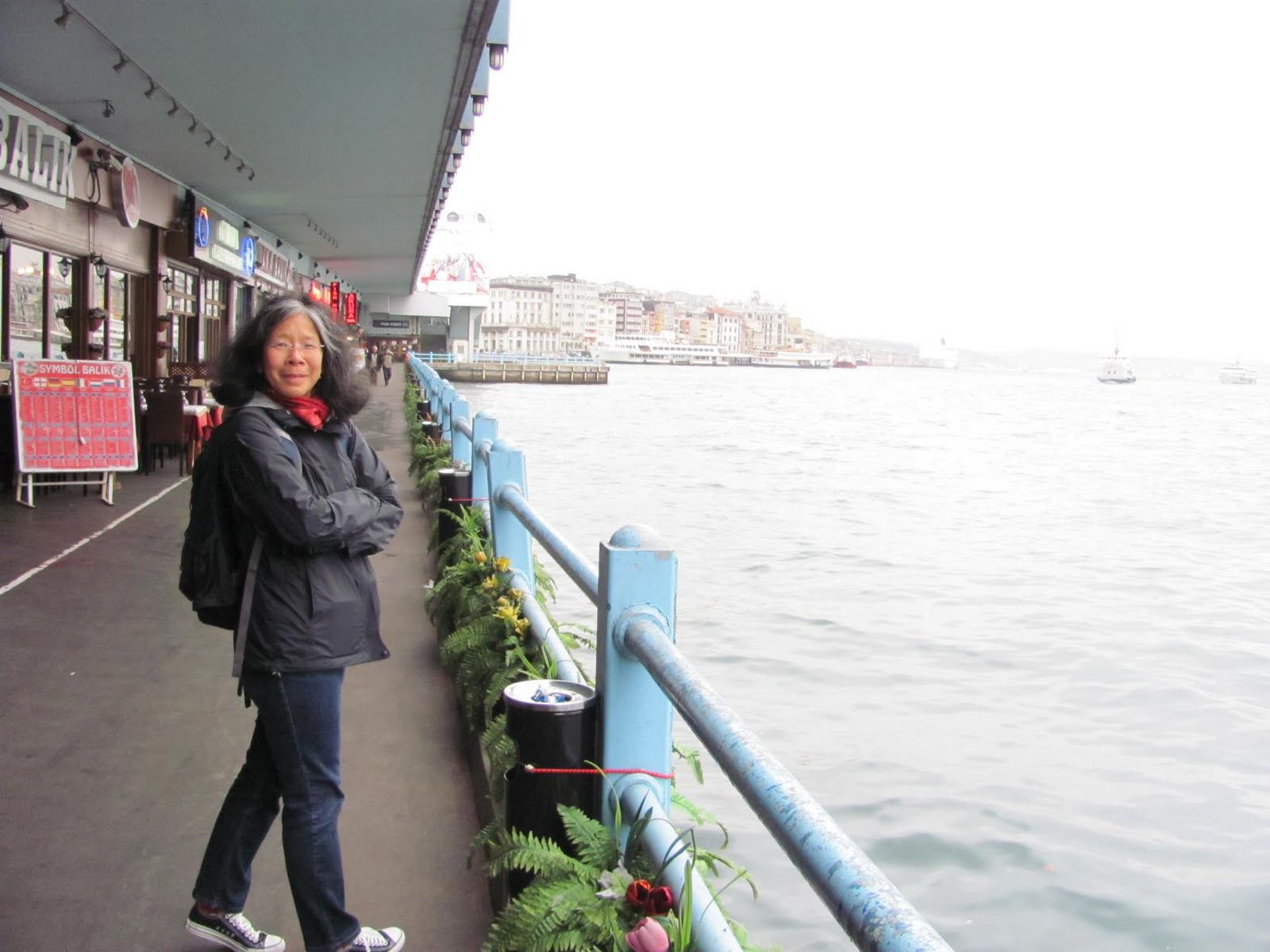
Most of the newer cafes, bars, and restaurants, along with the Pera Hotel, are in the northern section of European Istanbul, separated from the southern section where we stayed, by the Golden Horn, a body of water over which but linked by the double-deckered Galata Bridge, upon which you see Rose standing as we prepare to cross on the lower or restaurant level and brave the restaurant solicitors who insist on walking with us and telling us their menu, everyone of which offers better and fresher food than all the others on the bridge, and there are about 60 or so of them. It's a mildly daunting gauntlet.
Rose on Galata Bridge, heading north.

As you can tell, I can go on and on. So I'll try to finish quickly with just a few more pictures. The first one is of a fellow working hard up hill, although you can't tell from the picture that it is a steep climb. He is the third of three men, equally burdened, in quick succession.


The Blue Mosque, across the park from Aya Sophia, looking west.


The Blue Mosque is almost as gorgeous and inspiring as Aya Sophia, but we had been in a few mosques, seen so much beautiful tile, that by the time we visited the Blue Mosque on our last day, we'd almost lost our interest but once in we were again jaw-dropped by the intricate tile work, the enormous arches and domes, and all the beauty. Inspiring (pun ever so slightly intended).


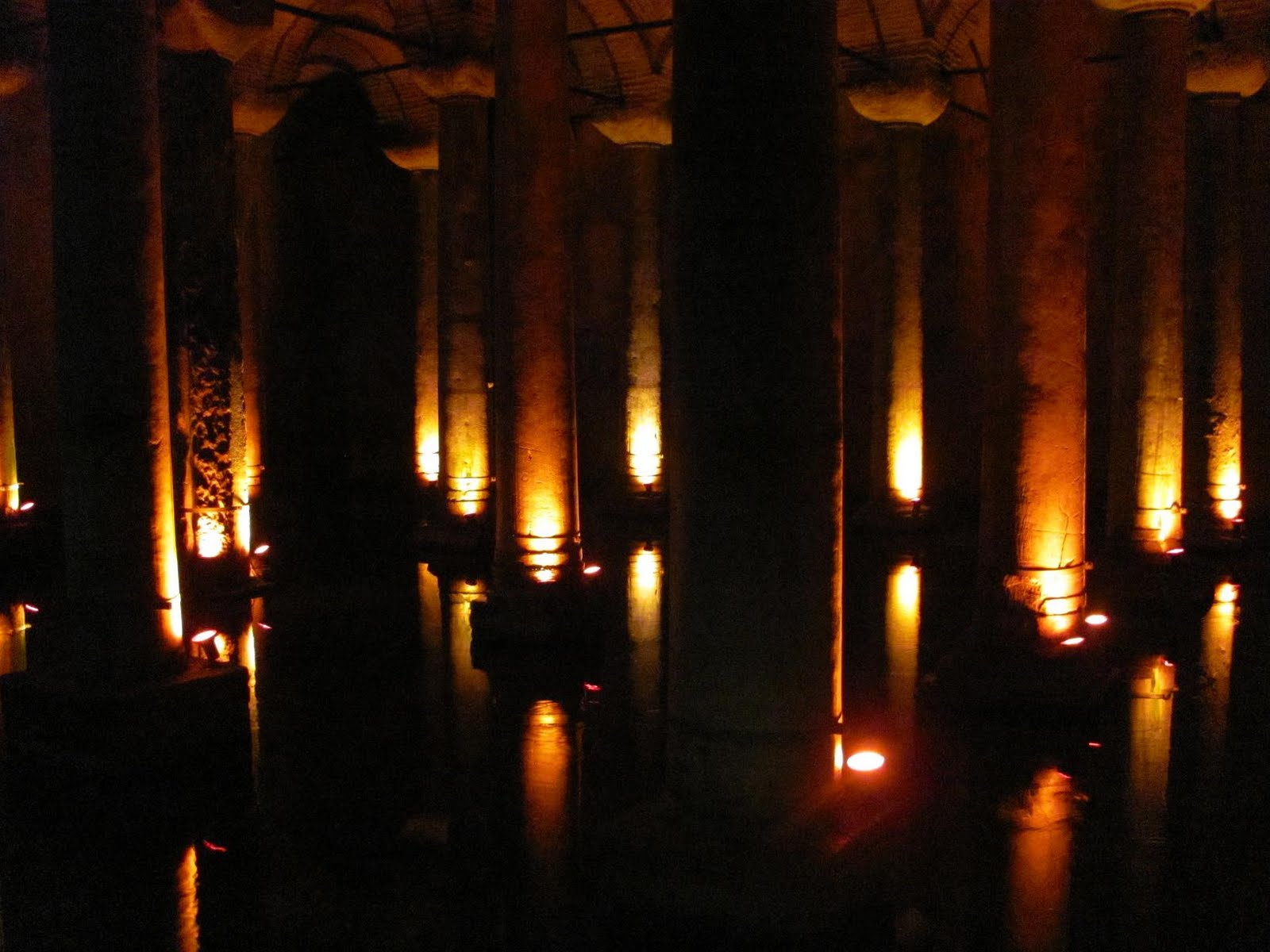
On our last afternoon we visited the old Roman cisterns,underneath the houses across the street from the Aya Sophia. Eerily lit and very cool, the cistern is a wonderully spooky way to spend a half hour or so, strolling the boardwalks that wind in and out between the pillars. No one knows quite when they were built but the safest assumption is around the time of Emperor Justinian, so 500 AD ish. But they were forgotten about for a long time and only discovered again in the 1500s by a Frenchman who noticed people dropping buckets down through holes in their floors and hauling up fresh water. When he investigated, he found the cisterns. It's still a mystery, though, about how the lights survived so long.

Rose has developed the habit of becoming obsessed with the national symbol of whatever country we visit. In Rome it was all things Pinnochio--a marionette, wine stopper, quill and ink, pencil holder, t-shirt, and wrapping paper. In Istanbul it was the whirling dervishes on bowls. Here are the ten little ones she bought, now artfully arranged in our dining room, just so. She can tell when I've moved one, and she gets particularly upset at our cleaning lady on Wednesdays because she moves them all. As I said, it's a bit of an obsession, sort of like the whirling dervishes themselves.
Finally, we got escorted in to an old wooden house beside the cistern to look at some rugs, even after I guaranteed the fellow we had plenty of rugs in Saudi and wouldn't be buying one here. He assured me that he would be happy if we looked and did him the honour of visiting his humble shop. To get to the point, we bought a rug that we really liked; we were worn down by cups of tea, the charm of the salesman and, in my case, an Effes lager, not to mention the beauty of the thing.  So now we have a Turkish carpet, which I guess is not a bad thing. That's it in the picture.

Istanbul is loaded with so  much history, so much colour, and so much to do. If you haven't been, go. But be strong-willed when a pleasant fellow tries to tell you his uncle owns a little shop and he'd be honoured if you would just step inside. You may find out he's your brother.

Tuesday, March 15, 2011

Jordan: Amman, Petra, Jerash and the Dead Sea

Sometimes life in Yanbu reminds me of that Neil Young song that begins "I was lyin' in a burned out basement, with the full moon in my eyes. I was hopin' for replacement when the sun burst through the skies." Leaving Saudi for a visit to Jordan is a bit like that. We left lots of sunshine for more sunshine, but we also left a country with a sort of gloomy restrictiveness for one much more open. People are somewhat shrouded in Saudi (most women literally so) but in Jordan the faces more regularly beam. The capital, Amman,a city of four million, felt much smaller, very friendly, and quite welcoming.

Built like Rome on seven hills, Amman has a lot of up and down to it, and at the bottom, right beside the main shopping area, the "main street," is an ancient Roman amphitheatre which cost one dinar (a whole buck fifty) to enter.


The city is thought to be the longest inhabited city on the planet with population data going as far back as 10,000 BC. About 300BC its name is changed to Philadelphia and then somewhere around 150AD the Romans take over and build this amphitheatre. And there it sits, probably still used for music, dance, what have you. It is one of those places that inspires, spooks (but in a good way), and enthralls. We could have spent hours. You can see from the look on Rose's face that those seats have an effect.


From Amman, we headed south to Petra, a three hour drive that took us through a lot of desert scrub land, into very old rolling stony hills, and finally into the valley of striking sandstone cliffs, chasms, and outcropppings. We were agape during the long steep descent into the town of Petra.That's the town in the background, surviving as far as I can see on the trade that the famous tourist attraction brings. The sandstone caves and cliff homes are in those darker hills in the back left of the photo. Once you enter the site, it's an exciting winding walk of about 4 or 5 km along a chasm floor which opens out in places to become more of a canyon or valley floor, but always on both sides rise vertiginous cliffs, usually with homes, tombs, or meeting halls carved into them.


Here you can see Rose and Marsha about to enter the narrow chasm that leads down to the centre of the ancient carved town. This goes on for about 2 or 3 km until you come to a stunning facade called the Treasury, and it is a gasp-inducing sight.Meanwhile, your neck feels the strain of constantly looking up at the soft undulating walls, often showing a varying array of natural colours. You can see in the one photo here all the colours occurring naturally in the ceiling and the walls. It seems there has been some polishing involved, but nonetheless it is remarkable.
The Treasury, all carved from the stone face.


One of many entry rooms, but notable for its polished ceiling.
Me sitting at the foot of an apartment complex.


From Petra,we headed back to Amman with our driver, Jamaal, for next day's excursion to the ancient Roman city of Jerash, just north of Amman, and then the Dead Sea in the Jordan valley. Jerash was built by the Romans starting around 60 BC. It is a huge spread of a ruin, covering many acres. We saw a re-enactment of Roman soldiers attacking barbarians and then did a tour of the ruins.
I'd pick the middle one to be on my team, I think.

   Two of the more interesting sights at Jerash, and there were loads to choose from, include this long Roman causeway with what must have been a pretty spectacular set of buildings in its heyday, along with that endless line of columns along the other side. And the second picture below is of the columns in  the Temple of Artemis. I took that picture lying on my back at the base of them. One of them sways a bit if there's a strong breeze; in fact, a small spoon has been inserted in the base of the column and with one hefty push anyone can make the column move, as the local coffee vendor showed me, pushing with one hand on the column and pointing with the other at the spoon that moved slowly up and down as the pressure from the column dictated. An earthquake in the 17 or 1800s cracked the column and it's been swayable ever since.

Roman road/pedestrian way


Columns at the Temple of Artemis, from the ground up.


The columns on the left appear in the picture above.

Oh, two other things. First of all, we never expected to see and hear Jordanians in traditional dress playing the bagpipes. And they played Amazing Grace. What's that about? In the other pic, you see our driver bargaining with a roadside nut and dried fruit vendor. He gesticulates admirably but we still aren't sure that he saved us money. Fun for us to watch though.
                                                                                                                                                                      And finally, The Dead Sea. Besides being a place I never really thought about because it never occurred to me that I'd some day get to visit, it provides one of those unforgettable experiences made so by simply  being uniquely strange. First of all, and you may well know all of this already so bear with me, it is the lowest inhabited place on earth, over 400m below sea level. It is impossible to sense that while you're there, but you're  mindful of it nonetheless, even though there is nothing visual or physical to indicate this odd fact. OK, there's a sign, but that's not what I mean. Then there's the water, but nothing to indicate that it will feel like light olive oil when you get in, and it does feel oily like that but not in an unpleasant way . . . much. Lying down in it involves some suspense (pardon the pun)  because you expect to sink. All your senses tell you that. But you don't; the floating feeling is quite wonderful, once you get your balance sorted out. Physically, you're in a position you've never been in before, so it takes some getting used to. Then it's like you are lying in some gorgeous hammock, one that allows you to paddle about, slowly drift and turn, and almost fully relax, as at least one of the pictures below indicates.
Not everyone wanted to take the plunge.
Salt clings to the stones.


Dead Sea rock nymphs.


I bid you all a fond farewell. Put Petra and The Dead Sea on your to-do list.

Tuesday, February 22, 2011

The Metaphysics of Cheese

I have no idea if this is the place for this rant, but here goes.

Having gone for a run in lovely 24C weather, and feeling like I had thus earned a glass of grape "cordial" along with some cheese, I took out the last bit of St Albans and warmed it up in the microwave so it would be a bit easier for my ryvita crackers to deal with. What struck me was the stunning aroma, that thrice dead gym sock odour that accompanies all decently aged cheeses warmed to perfection. Instantly I was reminded of a rather embarrassing episode which occurred in my second year of college. Having met a young woman with whom I was very interested in sharing life altering experiences, I took her out to a very cheap dinner and then back to my college room for some wine and cheese and late night chat.

It was a winter night. My dorm room was cold, so I had earlier thought to turn on the ancient radiator in my room so as to make things more comfortable. What I had forgotten was that two pair of recently worn running socks were drying on that same radiator. When we entered the room, it was not only as balmy as a Saudi June afternoon, it also smelled as if I were a serious manufacturer of cheesy comestibles, mostly of the blue, roquefort, or seriously aged havarti type. She turned to me and said her favourite cheese was gouda.

My heart fell.

Gouda! Isn't that the sort of cheese that people who don't acutally like cheese eat? Or if not that, then extra mild chedder? The cheese that isn't cheese. The cheese that those same people who used to eat Elmer's glue in grade school preferred. The sort of people whose favourite sandwich is breast of turkey with mayonnaise on white bread, and a glass of milk. Now, don't get me wrong. I enjoy breast of turkey and I even at times enjoy mayonnaise, but enjoying gouda may well be proof that the devil exists (Wal-mart and television notwithstanding)

Being a non-believer, it somewhat grieves me to say that we've been blessed with noses and a clear sense of smell, and to not put that to good use is to some extent a crime against existence itself. In support of Darwin, god bless him, our noses have evolved to what we have now because wisdom teaches us that the ability to smell powerful things is a form of higher development. This philosophy leads quite naturally to the conclusion that Gouda is the instrument of the devil and that the finest stinky cheeses may in fact be an argument for monotheism, or some sort of theim.

If there is a god, then she gave us noses so they may be well used; they are not meant to be insulted by things like non-aromic cheeses which lend themselves more to reminders of wall paper paste than to things worth experiencing more fully: smelly cheeses, for instance. Life, god or no god, is meant to be experienced, else why do we have the senses we do? But I begin to foam and rave, curdle, as it were.

Suffice to say, the aforementioned young woman and I went nowhere, much to my delayed delight. She probably found some Wonder Bread eating lover of mild cheddar while I have gone on to the joys of curried rice, garlic pasta, and St Alban's heavenly ordoriforous curds and whey. I speak both metaphorically and literally. Long may the finely sliced, well aged, smoked cheddar reign. Long may the bluers of cheese mould gloriously on.

Sunday, February 20, 2011

Dinner in the Desert

As we sat on our haunches beside a slow-burning fire, our host described his family as 'half Bedouin', with homes in the town and this now much reduced camp or small farm holding as a type of evening or weekend retreat. His father, quietly smoking, raisin-complexioned, and comfortably cross-legged sat silently as our host told us how at one time the father herded, milked, and generally farmed 60 camels in the area where now there were six, along with about 30 or so goats, and several sheep.That's Olly, grade three teacher from New Zealand, sitting with the patriarch.

The little grey camel you see below the picture of Olly is just three weeks old while the others are a few months.

We ride into work each day on a 20 seater bus which Muhammed (you'll see him later in the pics, the fellow with the black thobe) drives for us, and let me tell you that in the kind of traffic he has to drive through--speeders, cutters-off, swervers, 11 year old Mario Al-Andrettis, and so on--he is masterful and careful at the same time. Quiet, unassuming, friendly, struggling but game with his small English. We all really like him. We seem to have hit it off because not too long ago he invited the seven regulars along with a couple of others to come to his family's farm retreat to see his camels and to have a light meal. Last night's visit is the result, and it was very touching, very humbling, and very very cool.

The fellow in this picture is an Egyptian who stays at the farming compound year round to feed, milk, and look after the animals. I feel bad that I cannot remember his name, but we met a lot of people last night, and I was probably a bit tipsy from all the sweet tea and camel milk.You can see he is a bit wary of the mother, but you can also see she is a bit wary of her camel-ette being manhandled. Moments before I got this shot, she had bent her head down and lightly butted him on the shoulder, probably as a warning that worse was to come if he wasn't careful. Look at her eye: she's watching very closely.

All the animals were guarded in their approach to us and probably for good reason. When you see how the front leg gets tied up for milking, you'll see that much of their treatment at the hands of humans involves discomfort and probably some pain.By the way, that's our driver doing the milking. It took me back to my summers and winter weekends on my Uncle Doug and Aunt Bernice's farm, minus the tied front leg.

Once the rides were over, we moved into a very comfortable outside parlour where tea was served quite formally. The youngest brother was being trained in how to do this properly, so extra attention to propriety on our part was called for. Often one doesn't know quite how to act as a guest in the home of a host whose roots are foreign and this was a bit more complicated for us because we were being entertained in the home of a family for whom in some ways we symbolised an occupying force. (There are about six million Saudis and over one million expats, and we're the ones who do a good deal of the more meaningful labour: oil execs, teachers, doctors, engineers, and so on, but this is changing, albeit slowly. Many expats do pretty menial stuff too: house cleaning, garbage collection, corner shops, street repair.) In this case, though, we felt nothing but welcomed and respected.

Notice Rose of the Desert perched somewhat royally above it all. Getting onto a camel is like a slightly too large piece of cake, a bit more than you expected or hoped for; in many ways it's a bit like mounting a large bicycle. However, sitting on the camel while it gets itself up off the ground is a lot like sitting on your sofa while being lifted by a giant wave: first you plunge well forward, then you plunge far backward, then finally everything comes steady, but by this time you're so disoriented as to what's going to happen next, you start looking for the gravol . . .  or a chiropractor (at least I did). Once you're up though, the ride is delightfully smooth until the getting down part and then you are back on the nausea train.
In this picture you see Mohommed's older brother carefully straining the warm mild through a seive, probably to make sure none of the hundreds of flies have got themselves caught up in the delicious foam. These bowls were then passed out to us and you could tell it was a bit of a game for the natives as they were all smiles and close looks as we received and then dealt tentatively with the contents. As I said earlier, it reminded me of my days on the farm, so I tilted the bowl back and drank gamely, only to be pleasantly surprised by not only how warm the milk was but also how mildly sweet. No hint of sand, heat, or camel about it. Delish, as they say.

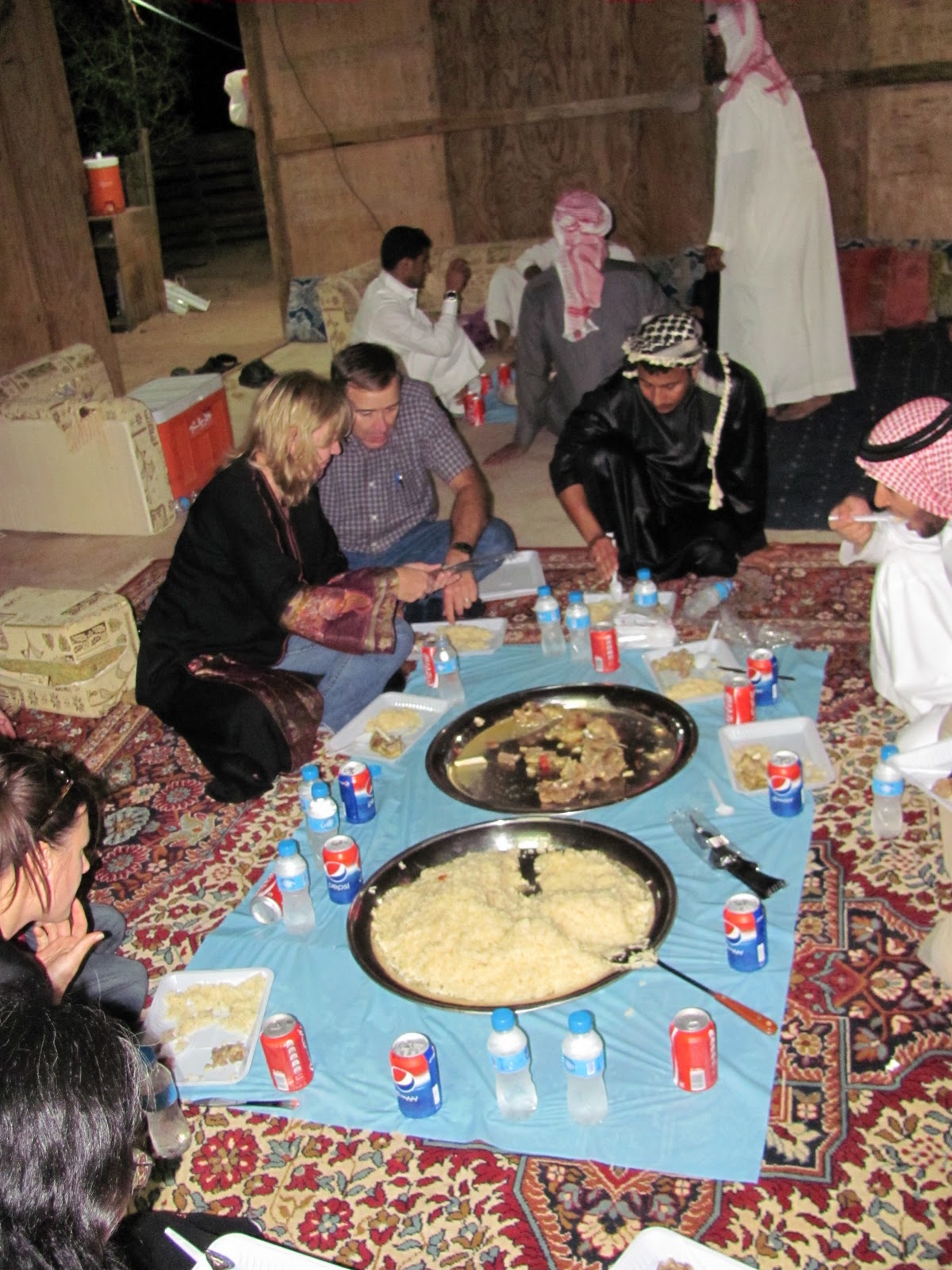
This preceded a traditional Bedouin meal of meat boiled in spicy water for about an hour and a half, served with a small mountain or rice. Normally, this would be eaten by hand--the right hand only--by making little balls out of the meat and rice which are then popped into the mouth. For us, the whole line of cutlery was provided, but a few of us chose to get good and greasy, using the hand method. It was delicious. The fat is left on the meat, perhaps because it's a sign of well-fed animals and this in turn is a sign of prosperity, but I am only guessing. I managed to avoid most of the fat without avoiding most of the taste. Like the milk, it was delicious.

The night ended with a drive through the starry desert, thanks again to Mohammed our driver, who left the dishes for the others to tidy up. We were well fed, well treated, and well satisfied by our excursion into the private lives of people we live and to some extent work closely with but who remain in many ways a distant mystery. Shukraan (shook rawn), Mohammed. Shukraan.